Regional Centre, Bhubaneswar
About Centre
Realizing the slow development of poultry production in Eastern and North-Eastern parts of India, the Regional Center of Central Avian Research Institute was established by the ICAR to initiate research on various aspects of poultry, particularly duck production, which are of direct relevance to this region. The regional Centre has Avian Genetics and Breeding, Avian Production Management, Avian Nutrition and phyology, Extension, Avian Medicinesections. In addition, the Centre has Hatchery, Experimental farms and Feed Technology unit, marketing section etc. Duck is the priority area of research. Supply of duckling and eggs are the prime revenue generating commodity for the centre.
History and Development
Regional Centre of Central Avian Research Institute had taken birth on 26th July, 1992 at Choudwar of Cuttack district of Orissa. Here, the activities of the centre started initially in a rented house. Extension works on popularization of backyard poultry was initiated from there when the rural farmers of Orissa were quite ignorant of the production practices and the benefits of it. In October, 1998 the centre was shifted to Bhubaneswar and had started functioning in a rented house at Baramunda. Research activities to certain extent were carried out by keeping few experimental birds in one of the deserted-shed of Central Poultry Development Organization, Bhubaneswar. The foundation stone for the present office- cum- laboratory building was laid by Hon'ble Chief Minister of Orissa, Sri. Naveen Pattanaik on 21st June, 2000 in the presence of Hon'bleDr.DebendraPradhan, Minister of State for Agriculture, Govt. of India and Dr. R. S. Paroda, Secretary DARE & DG ICAR. The Centre’s office was finally shifted to its own new campus on 6th October, 2003, which was inaugurated by Dr.MangalaRai, Secretary DARE & DG ICAR. Subsequently, the brooder shed, duck shed, experimental hatchery and feed plant came up. The present campus is situated on a land of 62 acres (31 acres for each) shared by both the ICAR institutes i.e. Directorate of Research for Women in Agriculture (DRWA) and Regional Centre, C.A.R.I.. The original land was a part of O.U.A.T. and was subsequently transferred to ICAR for establishment of these two institutes. This is a place, which is well connected by road, rail and air to all parts of the country.
Location and Climate
The Regional Centre, CARI is located in the heart of the capital city, Bhubaneswar. Bhubaneswar is otherwise called as the city of temples . It is located in front of Kalinga Studio, which is 1km away from the N.H. 5 and shares a common campus with DRWA. The campus is adjacent to the famous Chandaka elephant sanctuary and 3km away from important tourist destination called Khandagiri and Udayagiri.
Contact Address
Dr.R.K.S. Bais, Incharge, CARI Regional Centre,Jokalunda, In front of Kalinga Studio, Bhubaneswar-751003 (Odisha)
Tel No. : 91-674-2386870
Fax : 91-674-2386750
Mandate
- To conduct research on various aspects of Duck production, using both native and exotic breeds.
- To undertake research on backyard poultry production and develop package of practices.
- Conservation and maintenance of indigenous germ-plasm and testing of high yielding birds developed by C.A.R.I.
- Popularisation of duck farming among beneficiaries
Establishments
The Regional Centre has presently administrative-cum lab- building (with 11 rooms), two duck sheds, a brooder house, a hatchery, a feed processing unit, a store room; an experimental shed, an experimental pond , one pump house; two transformers, a jeep and a tractor. The laboratories are equipped for lab work.
The various facilities developed at the center in chronological order is as follows-
| S.No. | Year | Infrastructure Developed |
|---|---|---|
| 1 | 2003 | Administrative building- cum- laboratories (4 labs.) |
| 2 | 2004 | Experimental hatchery. |
| 3 | 2005 | Old duck shed |
| 4 | 2005 | Brooder -cum- grower shed |
| 5 | 2006 | New duck shed |
| 5 | 2007 | Feed plant |
| 5 | 2007 | Tractor |
| 5 | 2009 | Renovation of one old dairy shed for commercial chicken. |
| 5 | 2012 | Three new duck sheds |
| 5 | 2016 | Vertical extension of administrative –cum-laboratory building (in progress) |
| 5 | 2017 | Renovation of experimental hatchery initiated |
Salient Achivements
Performance evaluation of native, exotic and crossbred ducks :
- Maintained and evaluated Khkai Campbell, White pekin, Desi (native) and Moti ducks Comparative evaluation of Khaki Campbell(K), Desi(D) and their two reciprocal crosses (DK and KD) for duck day egg production up to 72 weeks of age revealed that DK crossbred produced highest eggs (220.09) followed by KD (188.42), K (170.45) and D(165.23) with egg weight of 70.22, 70.18, 69.64,72.38 g in D, K, KD and DK, respectively. Significant difference was observed for body weight and egg weight at different age of measurements between the genetic groups. Haugh Unit calculated at 72 weeks of age in D, K, KD and DK were 86.23, 91.03, 92.13 and 91.35, respectively.
- A 3X3 diallel crossing involving Desi(D), Khaki Campbell(K) and White Pekin (W) duck breeds showed significant differences for egg weight, body weight at 40 and 60 weeks of age between differenet genetic groups. Mortality per cent from 20 to 60 weeks of age was less in crossbreds than in the purebreds. The egg production and mortality in differrent genetic groups revealed that for dual purpose bird DW cross was found the best and for laying type DK was the best cross.
CARI Debendra performance:
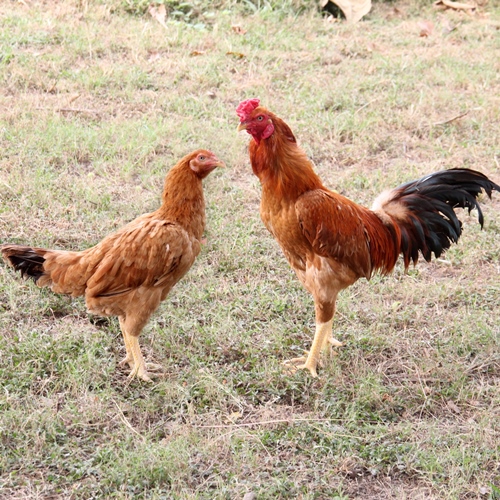
Parent lines of coloured plumage dual purpose chicken stock viz CARI Debendra are being maintained at Regional Centre, Bhubneswer for popularization in the region. This bird thrived well in intensive, semi-intensive and extensive poultry farming systems in villages of Odisha. The body weight at 20th week was 2596.38 and 2054.86 g in intensive and extensive system of rearing, respectively. The egg production recorded upto 60th week was 156 and 123 eggs on hen day basis in intensive and extensive system of rearing, respectively.
Nutrition and Feed Technology
Nutrient requirements of ducks.
- A diet with 22% CP and 2700 kcal ME/kg was found optimum for growth and feed conversion of native ducks during 0-8 wk of age.
- A diet with 16% CP and 2500 kcal ME/kg was optimum for growth and feed conversion of native ducks during 9-16 wk of age.
- During layer stage the ration containing 18% CP and 2750 kcal ME/kg was optimum for egg production.
Utilization of cassava(Manihot esculent crantz)
- Maize can be replaced by Cassava tuber meal upto 40% without affecting the performance of the broilers.
- Detoxification of cassava tuber meal by soaking and drying had no additional effect on nutrient utilization.
- Maize can be replaced by Cassava tuber meal upto 100% without affecting the performance of the White Pekin ducks.
Identification and utilization of available feed resources for backyard poultry rearing
- Different feed ingredients consumed by the birds from backyard system of rearing were identified and their nutritive values determined.
- Protein deficiency to the extent of 7.6 to 11.8% was observed in the diet of birds consumed from free range system.
- Supplementation of critical inputs during early stage of brooding and laying period showed beneficial results.
- The women of the small, marginal and landless labourer families take care of most of the activities of backyard poultry rearing.
- Further study is required to assess the production potential of dual-purpose birds in the backyard system of rearing.
Duck Reproduction
Semen collection technique from Khaki Campbell, White Pekin and Muscovy ducks has been standardized.
- Addition of vitamin E and selenium in duck feed to certain level increased egg production, fertility and hatchability.
Disease Management
Appropriate health coverage provided brought down the average annual mortality of ducks to 9.34 %. Month- wise highest mortality was found in April (38.74%) and lowest in March (0.39%). Major cause of mortality was due to enteritis (19.83%) followed by predation (17.93%), debility (14.94%), septicemia (14.13%), inanition (11.27%), pneumonia (4.75%), lesion obscured (3.8%), hepatitis (2.71%), egg bound (1.90%), blindness (1.76%) stampede (1.49%) and cannibalism (1.22%).
- Haematolohy of Ducks : The normal values of different parameters of ducks of three different breeds have been estimated. The estimated values of Hb in desi, Khaki and White Pekin were 10.05, 9.29,10.50; PCV 37.22, 34.20, 37.00; RBC 4.95,6.98,4.88; WBC12711.40, 13349.00, 16956.50; ESR (1hr) 4.14, 4.15, 2.18; ESR (2hr) 8.31, 7.57, 4.81 which revealed that there was not much variation in Hb, PCV, RBC but WBC, ESR, and bleeding time varied in these breeds of ducks. Differential count of lymphocyte, neutrophil showed variation among these breeds of ducks. However there was not much variation in other parameters.
- Isolation and Identification of Bacteria : A total of 15 samples of fecal and internal organs like kidney, liver was screened. Proteus mirabilis, Salmonella pullorum and E. coli were detected by microscopical, cultural, biochemical and molecular characterization (sequencing).
- Antibiogram of Isolates of Proteus Mirabilis : Proteus mirabilis was highly sensitive to ciprofloxacin, ofloxacin, enrofloxacin, medium sensitive to chloramphenicol, kanamycin and streptomycin but was resistant to cloxacillin and doxycillin. Pathogenicity test revealed 12.33%
- Seroprevalence of Duck Salmonellosis : A total of 188 sera samples of duck were screened by slide agglutination test against Salmonella antigen ( Salmonella pullorum) out of which 12 samples(6.4%) were found positive.
Technology Transfer
- The regional centre has been maintaining, multiplying and supplying germplasm of egg and meat type ducks in the form of hatching eggs, ducklings and growers as well as CARI Debendra chicks to beneficiaries in the region.
- Intensive rearing of ducks with artificial channel in run-space appeared to be an ideal management practice.
- CARI model of backyard chicken and duck farming enhanced household income and nutritional security to target beneficiaries.
- Integration of ducks with rice and fish yielded better economic return by improving water productivity.
Intregated Duck Rearing
Faculty Profile
| S.No. | Name | Status |
|---|---|---|
| 1 | Dr. Sanjeev Kumar | Principal Scientist & Incharge Head |
| 2 | Dr. Raj Narayan | Principal Scientist & I/C Quail Farm |
| 3 | Dr. Simmi Tomar | Principal Scientist & I/C Guinea Fowl Farm |
| 4 | Dr. Chandrahas | Senior Scientist & I/C Desi Fowl |
| 5 | Dr. Rokade Jaydip Jaywant | Scientist |